
If you’ve spent years behind the wheel of a heavy vehicle in the Australian transport and logistics industry, hauling freight interstate, operating on mining sites, managing fleet logistics, or delivering goods across Australia’s vast road network, chances are you already have the skills that qualify you for a formal truck driver RPL Australia pathway.
Many experienced workers in freight transport, logistics operations, and heavy vehicle driving already meet the requirements for a nationally recognised transport qualification, even without formal study. The question is: do you have the paperwork to prove your RPL for truck drivers Australia eligibility?
Without it, you could be missing out on career progression, licensing opportunities, and higher-paying roles. That’s exactly where truck driver RPL Australia comes in.
Recognition of Prior Learning (RPL) allows experienced transport operators to convert their hands-on work history into an official Australian qualification without sitting through months of classroom training you simply don’t need. In this guide, we break down everything you need to know about RPL for truck drivers, what it covers, who qualifies, what evidence you need, and how to get started.
Australia’s Transport Industry Is Crying Out for Qualified Drivers
Before we learn RPL process itself, it’s worth understanding just how urgent the need for formally qualified truck drivers has become.
In 2024, Australia had 28,000 unfilled truck driving positions. Factoring in the projected retirement of over 50,000 drivers, that shortage is expected to balloon to more than 78,000 unfilled positions by 2029.
The demographic picture is equally sobering. According to the 2024 Global Truck Driver Shortage Report by the International Road Transport Union (IRU), 47% of truck drivers in Australia were aged 55 or older, while only 5.4% of drivers were under 25.
Truck driving is currently the 9th most common occupation in Australia, and with road freight volumes expected to grow by 11.5% over the next five years, the demand for skilled, formally qualified drivers will only intensify.
For experienced drivers, this creates a powerful opportunity. Employers, licensing authorities, and regulators are actively seeking workers who can demonstrate formal competency and RPL is the fastest way to do exactly that.
How Long Does Truck Driver RPL Take?
The timeframe for completing truck driver RPL depends on how quickly you can gather your evidence and how efficiently your RTO processes the assessment. In most cases:
- Skills assessment: 1–3 business days
- Evidence preparation: 1–4 weeks (depending on documentation availability)
- Assessment and review: 2–4 weeks
Most applicants complete the entire process within 4 to 8 weeks – significantly faster than completing a formal traineeship or study program, which can take 12 months or longer.
What is Truck Driver RPL in Australia?
RPL for truck drivers is a formal assessment process that evaluates your existing skills, knowledge, and work experience against the competency standards of a nationally recognised qualification in Australia. Rather than studying what you already know, your real-world experience in freight transport, logistics, mining transport, or heavy vehicle operations is assessed.
If your experience meets the required standard, a qualification is issued.
In simple terms: if you can do the job, truck driver RPL Australia helps you prove it.
This approach is widely used across transport and logistics industry RPL pathways. The primary qualification available is:
TLI31222 – Certificate III in Driving Operations
This is a Nationally Recognised qualification under the Australian Qualifications Framework (AQF), issued by Registered Training Organisations (RTOs) that assess competency under the Transport and Logistics Training Package.

What Does the TLI31222 Certificate III in Driving Operations Cover?
The TLI31222 Certificate III in Driving Operations is the training requirement for most commercial vehicle licences in Australia, covering buses, coaches, tip trucks, line-haul and delivery vehicles, forestry vehicles, waste vehicles, and more.
Core competency areas assessed through the qualification include:
- Safe operation of commercial and heavy vehicles
- Fatigue management strategies
- Load restraint and cargo securing procedures
- Vehicle inspection and pre-trip checks
- Work health and safety (WHS) compliance
- Manual handling methods
- Emergency and accident procedures
- Chain of Responsibility (CoR) obligations
- Compliance with NHVR regulations and transport safety standards
- Driving in varied traffic and road conditions
- Completing required driver documentation and logbooks
For experienced truck drivers, most of these competencies are second nature, skills built over years on Australian roads. RPL simply formalises that experience.
Who Can Apply for Truck Driver RPL?
If you answer yes to most of the following, you are likely eligible for heavy vehicle driver RPL:
You hold a current heavy vehicle licence , HR, HC, or MC class. You have worked as a truck driver for 12 months or more. You can provide documented evidence of your driving history. You understand fatigue management, load restraint, and vehicle safety. You have experience complying with transport regulations and CoR obligations
RPL is particularly valuable for:
- Long-haul and interstate truck drivers with years of freight experience
- Civil construction transport operators who’ve worked on project sites
- Mining transport operators in WA, QLD, or NT without formal civilian qualifications
- Delivery drivers who’ve progressed into heavy vehicle roles
- Fleet supervisors managing driver compliance and logistics operations
- Skilled migrants with overseas truck driving experience seeking Australian recognition
- Container transport and dangerous goods drivers operating under specialised compliance requirements
Even if you are an experienced driver without formal study, your employment history, driving experience, and industry exposure may be exactly what you need to begin the RPL process.
How the Truck Driver RPL Process Works
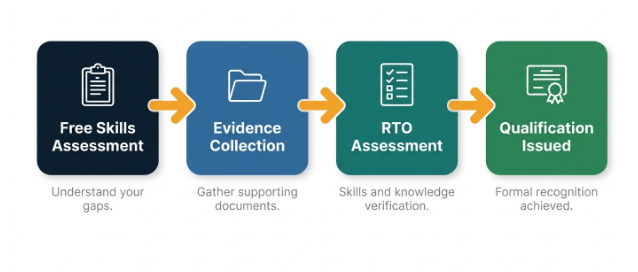
Step 1 – Free Skills Assessment
Your process starts with a free skills review. An RPL consultant checks your licence class, transport experience, and driving background to see whether you’re likely to qualify for the TLI31222 Certificate III in Driving Operations.
This step is simple, fast, and obligation-free.
Step 2 – Evidence Collection
Next, you’ll gather proof of your heavy vehicle experience.
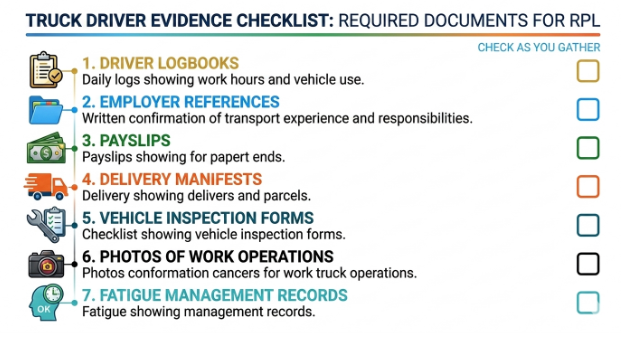
This may include:
- Driver logbooks
- Employer references
- Payslips
- Delivery manifests
- Vehicle inspection forms
- Photos of trucks or transport work
- Fatigue management records
Don’t stress if your paperwork isn’t perfect. A good RPL provider helps organise your evidence into a proper assessment portfolio.
Step 3 – Competency Assessment
A qualified assessor reviews your evidence against national transport competency standards. In some cases, you may also complete a practical discussion or workplace observation.
Step 4 – Qualification Issued
If your experience meets the required competency units, you’ll receive a nationally recognised qualification that is recognised across Australia.
What Evidence Do Truck Drivers Need for RPL?
When applying for truck driver RPL Australia, the quality of your evidence plays a major role in the assessment outcome. The purpose of the evidence is to demonstrate that your real-world experience matches the competency requirements of a nationally recognised transport qualification such as Certificate III in Driving Operations RPL.
Evidence for RPL for truck drivers generally falls into two categories: direct evidence and supporting evidence.
Direct Evidence for Truck Driver RPL
Direct evidence refers to documents that clearly prove your hands-on experience in the transport and logistics industry. This evidence helps assessors confirm your competency in heavy vehicle operations, freight transport, and transport compliance procedures.
Common examples include:
- Employment contracts or letters confirming your truck driving role
- Payslips showing your work history in transport or logistics
- Driver logbooks and fatigue management records
- Load restraint and pre-trip inspection documentation
- Dangerous goods transport records, if applicable
- NHVR compliance records and safety documentation
- Heavy vehicle licence details such as HR, HC, or MC licences
This type of evidence is highly valuable for heavy vehicle driver RPL and helps demonstrate practical experience across the core areas of the transport industry.
Supporting Evidence for Transport Operator RPL
Supporting evidence helps strengthen your truck driver skills assessment Australia application by providing additional context around your experience and responsibilities.
Examples of supporting evidence include:
- Supervisor or employer references
- Photos of trucks, transport operations, or worksites
- LinkedIn profiles or employment history records
- Industry certifications such as forklift, first aid, or elevated work platform training
- Records of short transport or logistics courses completed
- Proof of fleet management or delivery coordination responsibilities
For applicants working in freight, mining transport, logistics, or construction transport, supporting evidence can help demonstrate broader industry knowledge and operational competency.
The stronger and more organised your evidence is, the easier it becomes to prove your eligibility for truck driving qualification Australia through Recognition of Prior Learning. Consistent evidence across transport operations, vehicle safety, compliance, and driving responsibilities significantly improves the strength of your RPL application.
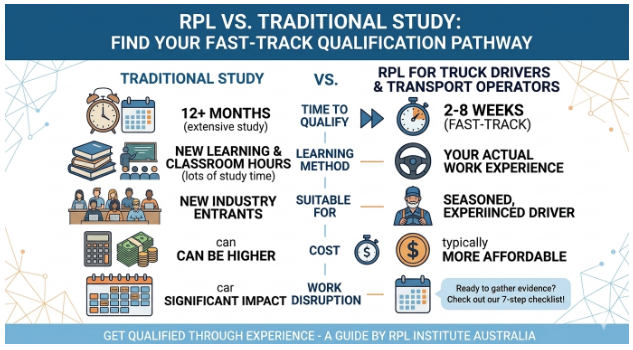
| RPL vs. Traditional Study: Which Is Right for Truck Drivers? | ||
| Factor | RPL | Traditional Training |
| Time to qualification | Weeks | Months to over a year |
| Classroom hours required | None (for skills already held) | Extensive |
| Based on | Your actual work experience | New learning |
| Cost | Typically lower | Can be higher |
| Disruption to work | Minimal | Significant |
| Suitable for | Experienced drivers | New entrants to the industry |
Benefits of RPL for Truck Drivers
One of the main advantages of truck driver qualification Australia through RPL is the ability to gain formal recognition without repeating training you already have practical experience in. This can save both time and effort while still leading to a nationally recognised outcome.
It also helps improve job opportunities, as many employers prefer or require formal qualifications for certain roles. In addition, it can support licensing pathways and demonstrate compliance with industry standards such as Chain of Responsibility and heavy vehicle safety regulations.
For many drivers, RPL becomes a way to turn years of experience into real career progression.

RPL for Specialised Transport Roles
One of the major advantages of truck driver RPL Australia is that qualifications can often be customised to reflect specialised areas within the transport and logistics industry. Through pathways such as Certificate III in Driving Operations RPL (TLI31222 RPL), experienced drivers may be assessed based on the specific transport environments they have worked in over the years.
For example, drivers involved in hazardous material transport may qualify under dangerous goods transport RPL, where assessors evaluate experience with ADG Code compliance, safety procedures, load restraint practices, and transport documentation. This type of heavy vehicle driver RPL is particularly relevant for operators working in fuel, chemical, or industrial freight sectors.
Workers with experience in mining and resource operations may also qualify through mining transport operator RPL pathways. Drivers operating heavy vehicles on mine sites across WA, Queensland, or the Northern Territory often have extensive experience with fatigue management, vehicle inspections, haul road safety, and transport compliance standards. These competencies can contribute strongly toward a truck driving qualification Australia assessment.
Similarly, applicants with experience in ports, shipping yards, or freight terminals may benefit from container transport RPL pathways. Drivers working in intermodal freight and logistics environments often possess valuable skills in freight coordination, heavy vehicle operations, and transport safety procedures that align with national competency standards.
For transport workers involved in infrastructure and construction projects, civil construction transport RPL may recognise experience operating tip trucks, earthmoving support vehicles, or construction transport fleets. This is common among drivers working on road projects, civil works, and large-scale infrastructure developments throughout Australia.
Long-distance freight operators may also qualify under long-haul interstate driver RPL pathways. Drivers with extensive logbook histories, fatigue management compliance records, and interstate transport experience can often demonstrate strong competency across multiple transport and logistics units.

RPL for Overseas Truck Drivers in Australia
Experienced drivers who have worked overseas can also benefit from skills recognition Australia pathways. International truck drivers may be able to use their driving history, employment records, and international licences as evidence for RPL assessment.
This is especially useful for skilled migrants who already have significant transport experience but need Australian-recognised qualifications to continue working in the industry.
By converting overseas experience into formal certification, drivers can transition more smoothly into the Australian workforce.
Cost and Duration of Truck Driver RPL
The cost of truck driver RPL Australia varies depending on the qualification level and the amount of evidence required. In most cases, it is more affordable than enrolling in a full training course because you are only being assessed, not retrained.
The process is also significantly faster than traditional study pathways. Many assessments are completed within a few weeks, depending on how quickly the required documents are submitted.
Career Growth and Industry Opportunities
Completing a heavy vehicle driver RPL qualification can open doors to better career opportunities within the transport and logistics industry. Many drivers use this qualification as a stepping stone into supervisory roles, fleet coordination, or logistics management positions.
It also supports work in sectors such as mining, construction transport, and long-distance freight, where formal qualifications are often required for compliance and safety reasons.
Why Formal Qualifications Matter for Truck Drivers
For many experienced drivers, obtaining a formal qualification through truck driver RPL Australia is not just about recognition it can also create better career opportunities and long-term industry security.
In the modern transport and logistics industry, employers increasingly value drivers who can demonstrate nationally recognised competency in areas such as fatigue management, load restraint procedures, vehicle inspections, and transport safety compliance. As Chain of Responsibility (CoR) obligations continue to expand across Australia, formal qualifications are becoming more important for both drivers and transport businesses.
A recognised truck driving qualification Australia may also support pathways toward higher-class heavy vehicle licences in some states, particularly where competency-based training requirements apply. For drivers working in mining, civil construction, freight, or long-haul interstate transport, qualifications can strengthen employability and improve access to higher-paying specialist roles.
Formal certification can also help experienced operators progress into supervisory, fleet management, compliance, or training positions within the logistics sector. For owner-drivers and contractors, qualifications may improve credibility when tendering for commercial transport contracts or working with large logistics providers.
As Australia’s freight and transport industry continues to grow, having a nationally recognised qualification through RPL for truck drivers can provide a significant professional advantage.
Why Choose RPL Institute Australia for Truck Driver RPL?
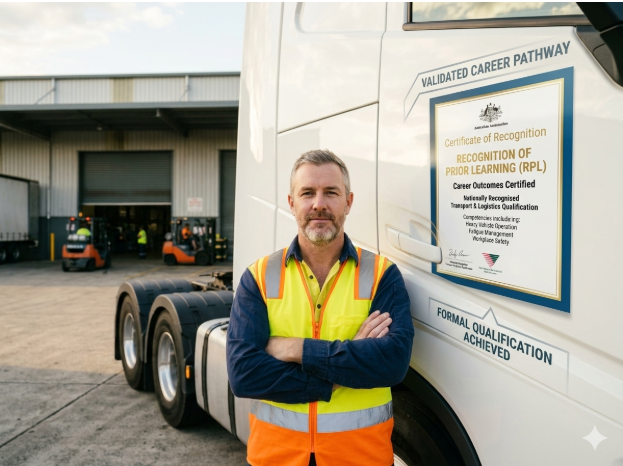
At RPL Institute Australia, we help experienced truck drivers and transport operators convert their real-world experience into nationally recognised qualifications through Recognition of Prior Learning.
Our team understands the Australian transport and logistics industry, including NHVR compliance requirements, fatigue management standards, heavy vehicle operations, and the competency requirements assessors look for during a truck driver RPL Australia assessment.
From your initial free skills assessment through to evidence preparation and submission support, we guide you through every stage of the process. Whether you work in freight transport, mining logistics, container transport, or long-haul interstate driving, we help ensure your experience is properly recognised.
If you already operate heavy vehicles, manage transport compliance, complete load restraint procedures, and work within Chain of Responsibility requirements, you may already have the skills needed for a formal qualification such as the TLI31222 Certificate III in Driving Operations RPL.
Ready to Get Your Truck Driving Qualification Through RPL?
Australia’s freight and logistics industry continues to grow, creating increasing demand for experienced and formally qualified transport professionals. For many drivers, Recognition of Prior Learning provides a faster pathway to certification without returning to full-time study.
If you have experience in heavy vehicle operations, freight transport, delivery driving, or logistics, a free skills assessment can help determine your eligibility for RPL for truck drivers.
Our team can review your work history, licence class, and transport experience to help identify the most suitable qualification pathway for your background.
Conclusion
For experienced drivers working in freight, logistics, or transport, truck driver RPL Australia offers a practical way to gain formal recognition without repeating training. By assessing your real-world experience against national standards, you can achieve a nationally recognised qualification that supports career growth, licensing pathways, and long-term opportunities in the transport industry.
FAQs
1. What is truck driver RPL in Australia?
Truck driver RPL is a Recognition of Prior Learning process that assesses your existing transport and driving experience against Australian qualification standards. It allows experienced drivers to gain a nationally recognised qualification without completing full-time study.
2. Who can apply for truck driver RPL?
Experienced truck drivers, transport operators, freight workers, delivery drivers, and heavy vehicle operators may be eligible for RPL if they can provide evidence of relevant industry experience.
3. What qualifications can I get through truck driver RPL?
Many applicants pursue qualifications such as Certificate III in Driving Operations (TLI31222 RPL) or other transport and logistics certifications based on their work experience and driving responsibilities.
4. What evidence is required for truck driver RPL?
Common evidence includes driving logbooks, employment references, licences, payslips, work history documents, and proof of transport or heavy vehicle experience.
5. How long does truck driver RPL take?
Most truck driver RPL assessments are completed within two to six weeks, depending on how quickly evidence is submitted and reviewed.
6. How much does truck driver RPL cost in Australia?
The cost varies depending on the qualification level and assessment requirements. In most cases, RPL is more affordable than completing a full transport training course.
7. Can overseas truck drivers apply for RPL in Australia?
Yes, overseas drivers may be eligible if they can provide evidence of international driving experience, licences, and employment history relevant to Australian transport standards.
8. Do I need an HR, HC, or MC licence for RPL?
Having an HR, HC, or MC licence can support your application, but eligibility depends on your overall transport industry experience and the qualification you are applying for.
9. Is truck driver RPL recognised across Australia?
Yes, qualifications issued through an approved Registered Training Organisation (RTO) are nationally recognised throughout Australia.
10. Can RPL help me get better transport jobs?
A nationally recognised qualification may improve job opportunities, support career progression, and help drivers move into supervisory or fleet management roles.
11. Is RPL faster than studying a transport course?
Yes, RPL is usually much faster because it assesses your current skills and experience instead of requiring full classroom-based training.
12. Can owner-drivers apply for truck driver RPL?
Yes, owner-drivers and self-employed transport operators may qualify if they can provide evidence of their transport operations and driving experience.
13. What industries value truck driver RPL qualifications?
RPL qualifications are recognised across freight, logistics, mining, construction, warehousing, and delivery industries throughout Australia.
14. Can RPL support transport licensing pathways?
RPL can support qualification and career pathways connected to transport licensing, compliance, and heavy vehicle operations within the Australian industry.
15. Why is truck driver RPL important?
Truck driver RPL helps experienced workers gain formal recognition for their existing skills, making it easier to meet industry standards and progress professionally.